
Ontology
Define device types, the metrics they emit, and their property schemas.
The Ontology consists of platform primitives which are configured to fit the exact shape and schema of your data: from the types of devices you have and the data they produce to transactions and integrations your workflows are composed of.
The typical starting primitives to onboard are the ones which represent the hardware types and data signals associated to those types:
- Thing types define a kind of device: which metrics it reports and which properties it carries. They're versioned.
- Metric definitions define a single measurement: its data type, unit, and default aggregation. Metrics are reused across many thing types.
The Ontology page has three tabs: a relationship graph (thing types linked to the metrics they include), metric definitions, and thing type definitions.
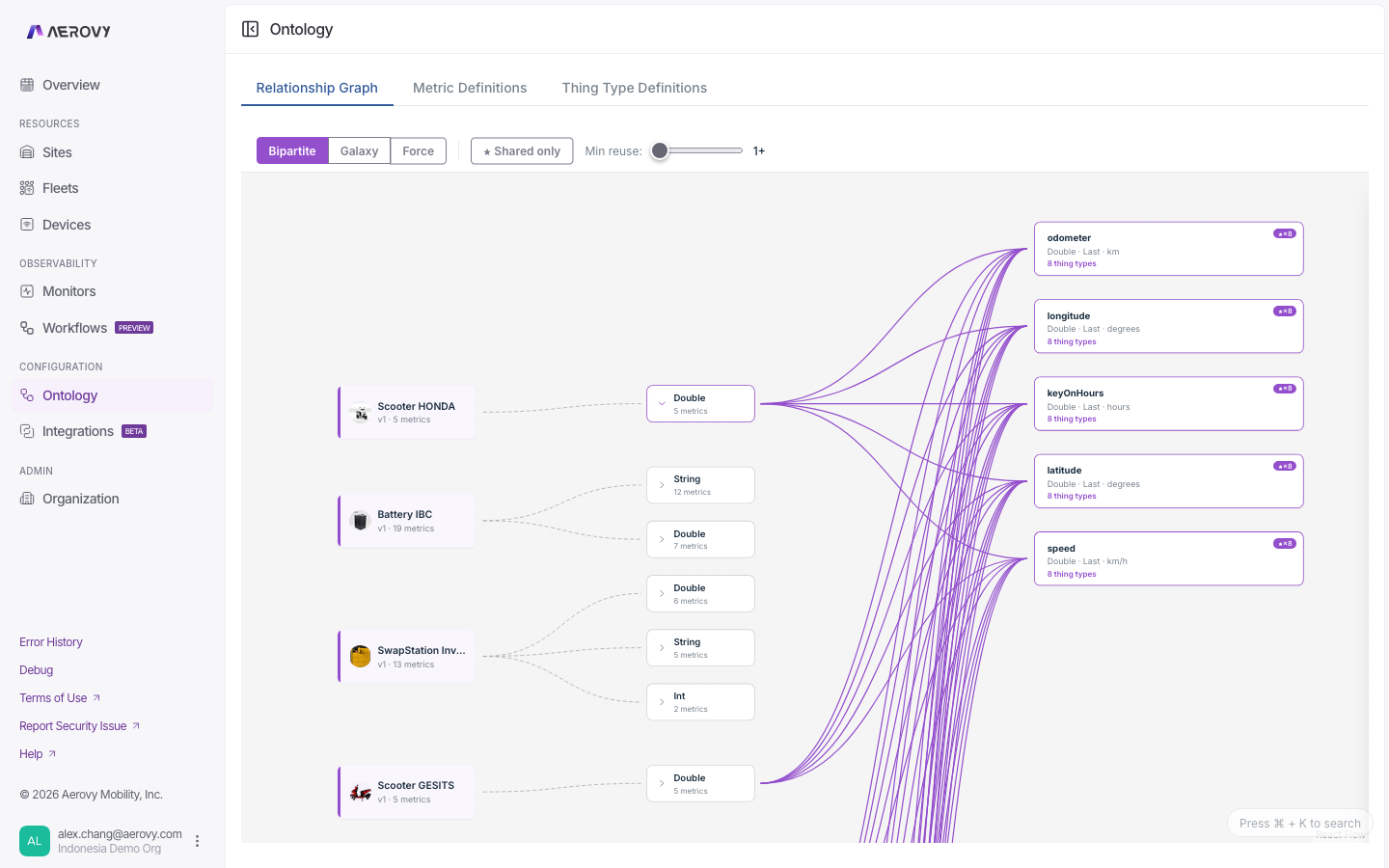
This page describes managing the ontology in the console. For the concepts behind it (how thing types reference metrics, how properties and versioning work, and metric reuse), see Data model.
Thing types
A thing type has a stable identity (the index, tdefi_) that points at its latest
version (tdef_) and keeps the full version history. A device binds to a specific version,
which fixes the metric set and property schema that apply to it.
Fields
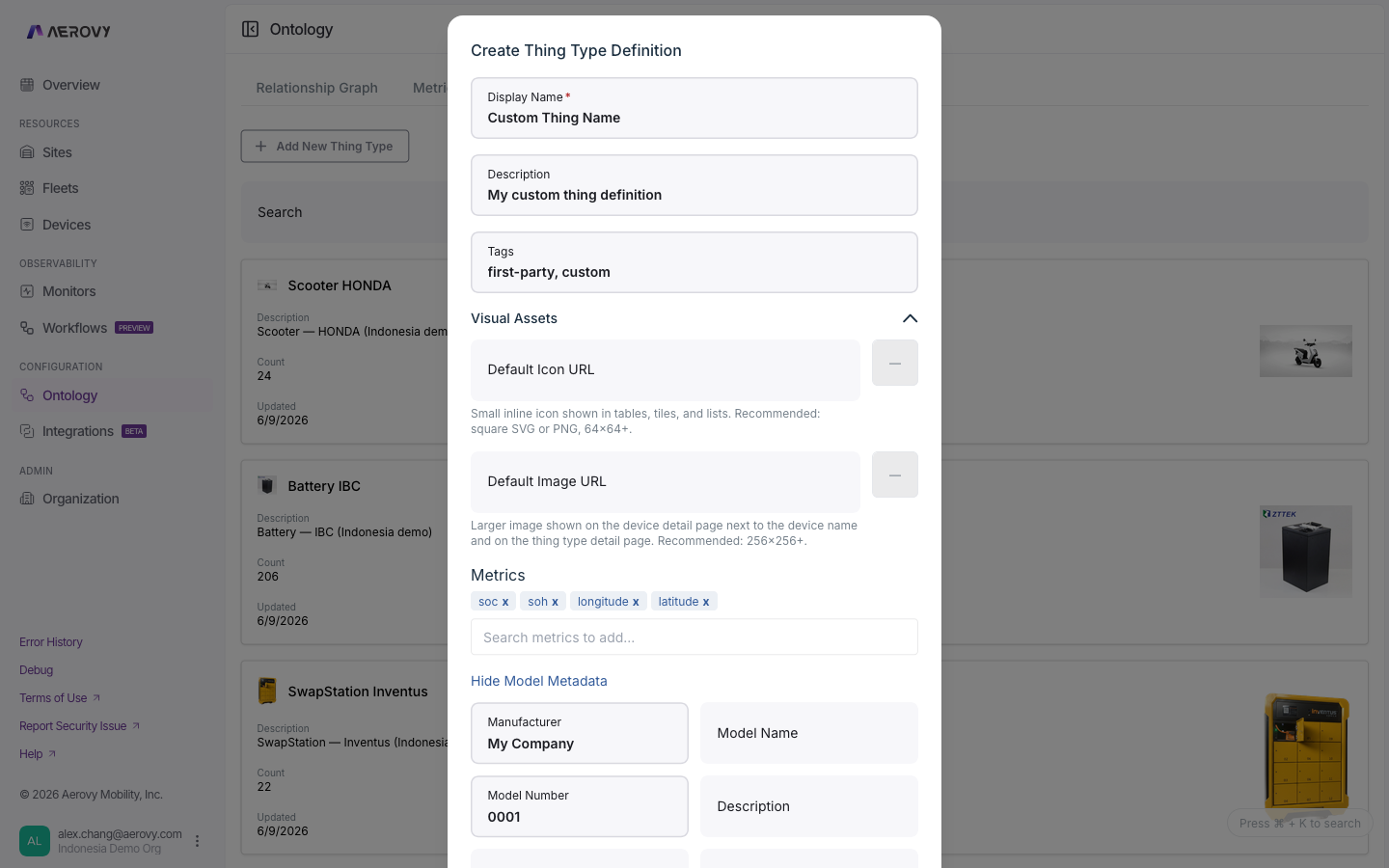
| Field | Type | Required | Notes |
|---|---|---|---|
| Display name | string (1–100) | Yes | |
| Description | string (0–500) | No | |
| Metric ids | list | Yes | The metrics this version reports |
| Property definitions | list | No | Typed property schema (see below) |
| Model metadata | object | No | Manufacturer, model, hardware revision, certifications, and more |
| Tags | list | No | |
| Default image / icon URL | URL | No | Index-level visual assets |
Versioning
Each version is a full snapshot. You change the metric set by creating a new version, not
by editing an existing one. The "create version" form pre-fills every field from the latest
version. A response also reports deletedMetricIds: metrics that earlier versions had but this
one dropped.
When updating an existing version, you can change its display name, description, tags, model metadata, and property definitions, but not its metric ids.
Metric definitions
A metric definition (surfaced as metricId) describes one measurement.
| Field | Type | Required | Mutable | Notes |
|---|---|---|---|---|
| Name | string | Yes | No | Programmatic name; fixed after creation |
| Data type | enum | Yes | No | See below |
| Default aggregation | enum | Yes | No | See below |
| Display name | string | No | Yes | |
| Description | string | No | Yes | |
| Unit label | string | No | Yes | |
| Tags | list | No | Yes | |
| Enum values | list | No | Yes | Only valid when the data type is Int |
Data types
| Data type | Notes |
|---|---|
Int | Integer |
Double | Floating point |
String | Text |
Bool | Boolean |
Json | JSON document |
There's no separate "enum" data type. An enum metric is an Int with a non-empty list of
enum values, each mapping an integer code to a name (plus optional display name and
description). Codes are append-only and unique; names are required and unique.
Aggregations
defaultAggregation is how the metric is combined when binned.
| Data type | Allowed aggregations |
|---|---|
Int, Double | First, Last, Sum, Min, Max, Avg, Count |
String, Bool, Json | First, Last, Count |
Enum (Int + enum values) | First, Last, Count |
Arithmetic aggregations are disallowed for enums, since the codes have no numeric meaning.
Property definitions
Properties are typed, predefined attributes a device of this type carries (for example a battery's capacity). Each property has:
| Field | Type | Required | Notes |
|---|---|---|---|
| Name | string | Yes | |
| Value type | enum | Yes | string, int, double, bool |
| Description | string | No | |
| Unit | string | No | |
| Constraints | list | No | Validation rules (see below) |
A constraint is an operator plus a value. Operators: >, >=, <, <=, ==, !=.
When updating a version, omitting propertyDefinitions leaves them unchanged; passing a list
replaces them entirely; passing an empty list removes them all.
States
- Lifecycle status: list endpoints take
status=active(default),deleted, orall. Deletes are soft, so entities carry anisDeletedflag. - Graph layouts: the relationship graph renders as
bipartite(default),galaxy, orforce.
API
Send your API key in the X-Api-Key header. Reads need a read scope; create, update, and
delete need write. Ids: thing-type index tdefi_, thing-type version tdef_, metric
mdef_. These are version 2 endpoints. The thing-type endpoints are also in the
API Reference tab.
Thing types
| Method | Path | Purpose |
|---|---|---|
GET | /v2/definitions/thing-types | List thing types (paginated) |
POST | /v2/definitions/thing-types | Create a thing type (its first version) |
GET | /v2/definitions/thing-types/{thingTypeId} | Get one thing type |
PUT | /v2/definitions/thing-types/{thingTypeId} | Update index metadata |
DELETE | /v2/definitions/thing-types/{thingTypeId} | Soft-delete a thing type |
GET | /v2/definitions/thing-types/{thingTypeId}/versions | List version history |
POST | /v2/definitions/thing-types/{thingTypeId}/versions | Create a new version |
GET | /v2/definitions/thing-types/versions/{thingTypeDefId} | Get one version (?includeMetricDefinitions=true resolves metrics) |
Metric definitions
| Method | Path | Purpose |
|---|---|---|
GET | /v2/definitions/metrics | List metrics (paginated) |
GET | /v2/definitions/metrics/{metricId} | Get one metric |
POST | /v2/definitions/metrics | Create a metric |
PUT | /v2/definitions/metrics/{metricId} | Update mutable fields |
DELETE | /v2/definitions/metrics/{metricId} | Soft-delete a metric |